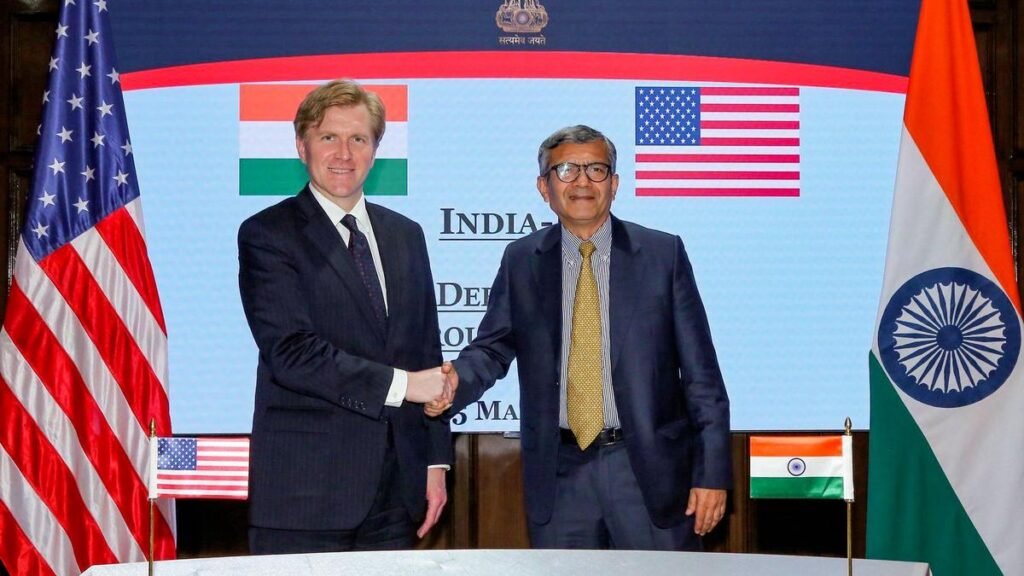
India–U.S. Defence Policy Group reaffirms commitment to expanding strategic cooperation
The recent meeting of the India–U.S. Defence Policy Group marks another step in the steadily deepening strategic partnership between India and the United States. This development is not an event; it reflects a long-term transformation in global geopolitics, defence cooperation and technological collaboration between two of the world’s largest democracies.
1. Understanding the Defence Policy Group
The India–U.S. Defence Policy Group is the institutional mechanism for defence cooperation between the two countries. It functions as an apex-level forum where senior defence officials meet regularly to:
* Review military cooperation
* Identify new areas of collaboration
* Strengthen alignment
* Guide defence policy direction
The 18th DPG meeting, held in New Delhi in March 2026 was co-chaired by India’s Defence Secretary and the U.S. Under Secretary of Defense for Policy.
This meeting reaffirmed a message:
India and the U.S. Are committed to expanding strategic, military and technological cooperation with India and the U.S.
2. Historical Background of India–U.S. Defence Relations
2.1 Cold War Era: Limited Cooperation
During the Cold War:
* India followed non-alignment
* The U.S. Aligned with Pakistan
This limited defence ties between the two countries.
2.2 Post-2000 Transformation
After 2000 relations improved significantly due to:
* Shared concerns about terrorism
* Rise of China
* globalization
In 2016 the U.S. Designated India as a “Major Defense Partner” enabling access to advanced military technologies.
2.3 Foundational Defence Agreements
Key agreements include:
* LEMOA (Logistics sharing)
* COMCASA ( communications)
* BECA (geospatial intelligence)
These agreements laid the foundation for interoperability and trust between India and the U.S.
3. Key Highlights of the 2026 DPG Meeting
The DPG meeting focused on expanding defence ties in multiple dimensions.
3.1 Shift from Buyer–Seller to Co-Development
One of the important developments is the transition from:
* Traditional arms purchases
To
* Joint development and production with India and the U.S.
Both countries identified priority areas for co-development and co-production of defence equipment with India and the U.S.
This reflects an equal partnership, rather than a transactional relationship between India and the U.S.
3.2 Focus Areas of Cooperation
The meeting emphasized collaboration in:
* Advanced Weapons Systems
+ Precision-guided munitions
+ Artillery systems
+ Missile technologies
Example:
* Excalibur precision-guided shells deal worth ₹300 crore
* Anti-Tank and Tactical Systems
. Possible procurement of Javelin anti-tank missiles
* Maritime Security
+ Surveillance aircraft (e.g. P-8I)
+ Naval cooperation
* Surveillance and Intelligence Systems
+ Advanced ISR (Intelligence, Surveillance, Reconnaissance)
* Emerging Technologies
+ Drones
+ AI-based defence systems
+ Cybersecurity with India and the U.S.
3.3 Strengthening Military-to-Military Cooperation
Both sides reaffirmed commitment to:
* Joint military exercises
* Training programs
* exchanges with India and the U.S.
These activities improve:
* Interoperability
* Operational coordination
* Crisis response capability
3.4 Expansion of Defence Trade
The meeting also discussed:
* New defence acquisitions
* Timely delivery of existing contracts
India is exploring:
* P-8I aircraft
* Precision artillery systems
4. Strategic Context: Why This Cooperation Matters
4.1 Indo-Pacific Geopolitics
The Indo-Pacific region has become the center of strategic competition especially due to:
* China’s rising military power
* Maritime disputes (South China Sea)
* Trade route security
The U.S. Sees India as a partner to maintain balance of power in the region with India.
4.2 China Factor
The growing assertiveness of China in:
* Border disputes with India
* Indo-Pacific expansion
* Military modernization
has pushed India and the U.S. Closer together.
4.3 West Asia Conflict and Global Instability
The DPG meeting took place amid rising tensions in West Asia.
Conflicts are affecting energy supply
Military preparedness is becoming more important
This highlights the need for strong defence partnerships between India and the U.S.
5. Importance of Co-Development and Co-Production
5.1 Strategic Autonomy for India
India wants to:
* Reduce dependence on imports
* Build defence capabilities
Co-production helps:
* Transfer technology
* Strengthen industry
5.2 Benefits for the United States
The U.S. Gains:
* A reliable strategic partner in India
* Access to markets
* Strengthening alliances in Asia
5.3 Industrial and Economic Impact
Joint production:
* Creates jobs
* Boosts defence manufacturing
* Encourages innovation
6. Role of Defence Industrial Cooperation
6.1 “Make in India” in Defence
India aims to become:
* A global defence manufacturing hub
The DPG supports:
* Technology transfer
* Joint ventures
* Production
6.2 Emerging Areas
Key sectors include:
* Drone technology
* engines
* Maintenance, Repair, Overhaul (MRO)
7. Military Exercises and Operational Cooperation
7.1 Joint Exercises
India and the U.S. Conduct exercises:
* Yudh Abhyas (Army)
* Malabar (Naval)
* Cope India (Air Force)
These improve:
* Tactical coordination
* Combat readiness
7.2 Interoperability
Through agreements like COMCASA and BECA:
* Forces can share real-time data
* Improve awareness
8. Technology Sharing and Innovation
8.1 Advanced Defence Technologies
The partnership is moving toward:
* AI-enabled warfare
* Autonomous systems
* Cyber defence
8.2 Drones and Future Warfare
India is focusing on drone self-reliance by 2030.
This aligns with U.S. Expertise in:
* UAV technology
* Surveillance systems
9. Challenges in India–U.S. Defence Cooperation
Despite progress some challenges remain:
9.1 Strategic Differences
* India maintains autonomy
* Not a formal U.S. Ally
9.2 Trade and Tariff Issues
* Past tensions over tariffs
* Differences in policy
9.3 Dependence on Russia
* India still relies on defence equipment
9.4 Technology Transfer Limits
* U.S. Restrictions on sensitive technologies
10. Significance of the DPG Meeting
The 2026 DPG meeting is important because it:
10.1 Strengthens Strategic Trust
* Regular dialogue builds confidence
10.2 Expands Defence Ecosystem
* Moves beyond arms sales
10.3 Enhances Regional Stability
* Supports Indo-Pacific security
10.4 Promotes Long-Term Partnership
* Focus on technologies
11. Future Outlook
11.1 Deeper Integration
Expect:
* More joint production projects
* Expanded intelligence sharing
11.2 Defence Innovation
Focus on:
* AI
* Cyber warfare
* Space defence
11.3 Indo-Pacific Leadership
India and the U.S. Will likely:
* Strengthen QUAD cooperation
* Counter regional threats
The reaffirmation of commitment by the India–U.S. Defence Policy Group represents a milestone in bilateral relations.
The relationship is evolving from buyer–seller to partnership.
Focus is shifting toward co-development, co-production and technology sharing between India and the U.S.
Both nations aim to ensure stability in the Indo-Pacific.
Defence cooperation is now multi-dimensional—military, technological and industrial.
In a world marked by uncertainty, rising conflicts and technological competition the India–U.S. Defence partnership is becoming a cornerstone of global security architecture, with India and the U.S.