Nitish Kumar hijab video row: SP leader files police complaint against Bihar CM; seeks action
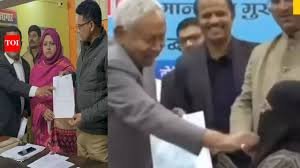
“The Nitish Kumar hijab video row” represents yet another instance of the very agitated and volatile political scene prevalent in the state of Bihar—this time not due to an policy announcement, a change of alliance patterns, or a statement given by any of the politicians, but due to a short video clip emanating from an official state function.
What the controversy is about
A controversy is essentially
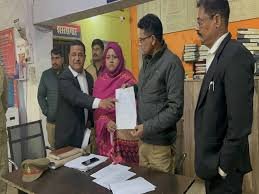
As reported from several sources, the issue started as a result of a video from an appointment letter distribution ceremony in the presence of the Patna CM. In the video, one can see the interaction between the CM of Bihar, Nitish Kumar, and a female doctor who appears on stage to collect her appointment letter. In their interaction, the CM is alleged to be reaching up towards the head or face covering of the woman and pulling it, which is interpreted as trying to pull off the hijab or veil she is wearing.
The female in the video has been identified as an AYUSH doctor (Dr. Nusrat Parveen) by various news sources, and according to Moneycontrol, the video is from a public event held in Patna on December 15, 2025.
Soon after the clip appeared on the internet, it was put to political use as well. The act of taking off her hijab was considered degrading, intrusive, and lacks respect for the person as well as the significance of the hijab the woman represents to the Muslims.
Why it felt like such a big deal, and so suddenly
In the Indian context, controversies surrounding religious identity signs (such as the hijab) easily snowball because they involve multiple levels of sensitivity:
Women’s autonomy and consent: Although in good faith one may believe that “it was casual” or “not malicious” when they reached out or touched a woman’s clothing, and particularly something she wears to be modest, this is still a serious transgression.
Power mechanism between public entities: This involves situation where thehighest ranking public official gives appointment to a professional woman to accept aletter of appointment at a public function. According to critics, power difference becomesmore pronounced with such setting where it becomes difficult for the woman to respondappropriately to preserve her freedom.
Religious and Cultural Symbolism: Taking off the hijab may carry more meaning than simply stopping the use of an article of clothing if it has religious or cultural significance for the wearer, even if the action was well-intentioned.
Political timing and politics of picture: Viral moments have the power to change perceptions more than political speeches. Political clips are used by their opponents to create perceptions about women, minorities, or political standards.
This is why the incident led to a national discussion within hours, unlike when it was a “local Bihar event.”
SP leader’s police complaint: what was filed, where, and against whom
One of the major developments is that the dispute is now being handled in the legal and police spectrum. According to news, Sumaiya Rana, the leader of the Samajwadi Party (SP), lodged an FIR against the following at the Kaiserbagh Police Station in Lucknow:
Bihari CM Nitish Kumar, and
UP Cabinet Minister Sanjay Nishad (tied up with statements made when he defended Nitish Kumar).
This is important because it confirms that the matter has spilled over not only into the state of Bihar but into the political sphere of Uttar Pradesh as well, not only because of the case being filed in Lucknow but also because of the statement made by the UP minister that has now become a part of the issue.
Why the name Sanjay Nishad?
UP Minister Sanjay Nishad made news Comments defending Nitish Kumar that got him more ire, termed as ‘controversy/misogyny’ in the reporting:
“The video showed Nitish Kumar telling the sisters to get married and have kids to continue the line,” Nishad
mint
Thus, it is not only about the act that is displayed in the video, but also about how the conversation that erupted afterwards contributes to demeaning women or disregarding their boundaries, if those complaining about it think so.
Other Grievances and “Zero FIR” Angle
Despite these pending
Other than the SP complaint, other reported cases involve another official act, which was published by the platform Moneycontrol: “A Bengaluru advocate filed a Zero FIR for the incident, claiming as the video was available in Bengaluru and was also watched in Bengaluru, it could be registered as an FIR in Bengaluru and then transferred to the concerned jurisdiction.”
Even without delving into more technicalities, one thing is clear on the surface: more than one complainant is attempting to move this thing into official legal proceedings, not allowing it to stay at an issue of media contention.
Reaction of the opposition and call for accountability
The video sparked strong reactions. According to Times of India, the opposition showed displeasure with the act, terming it “shameless” and inappropriate, thus questioning the behavior of the Chief Minister and the level of women’s dignity and safety.
As critics have argued, “There is a certain standard that is required of constitutional high-office-holders. You do not, or should not, touch a person’s religious or modesty-based attire.”
In most cases, opposition pressure has a few forms:
| This is particularly the case if the
Demanding an explanation from the government about the incident
Asking for police intervention or investigation
“Using the incident to counter the ruling party’s narrative of respecting women and taking care of the weak”
Although there may be no case at all that goes to trial, the opposition may be able to keep ‘the administration on its back’ through these kinds of complaints.
‘There’s just too much
The government’s defence: ‘fatherly affection’ and intent-based arguments
On the other side, Bihar’s Minority Affairs Minister, Zama Khan, defended Nitish Kumar and called such an act of “fatherly affection” and said that the opposition is politicizing the matter.
Similarly, the Indian news network NDTV also reported a “defence line” coming from “the ruling side” that “Nitish Kumar ‘loves and respects daughters,’ and that the act was done so the world could see the face of a ‘successful daughter.’”
ndtv
This is significant, as it indicates how the ruling elite is trying to present this situation:
It was not meant to offend religion
It was not intended to be humiliating
It was a term of endearment or pride towards a young professional
The anger is politically driven
Why this defence is still contested
The BioNTech
Even when one agrees that the “intent” argument is correct, the counterargument is that intent does not nullify effect. In matters of bodily autonomy and modest clothing, consent prior to intent seems to carry more weight.
Example: In simple terms: “A leader may say, ‘I meant well,'” but the response from opponents would be, “Well-meaning individuals may have violated boundaries.”
The larger social issue: dignity, consent, and public performance
This is now part of a wider battle within Indian society:
1) What is a definition of consent in a public setting?
In an official/professional setup, consent is not merely an issue of “did she object loudly.” This is because the element of power could mute objections. A woman may feel inhibited in responding if she is getting an appointment letter from the Chief Minister on stage.
2) Is the minority identity symbol respected by the state?
In the context of Muslims, especially Muslim women, issues concerning hijab are viewed as an attempt by social entities to regulate what they wear. This is because a video of what seems like one of the top-level officials attempting to remove a hijab is enough to fan those flames, even when interpreted differently by some.
3) Arerien Model of Respectful Behavior?
Holding public office means more than just administering a set of policies. Holding office is also about symbolic behavior. Leaders are role models. This kind of footage might be harmful simply by creating a perception, whether accurate or inaccurate, that this is how one can act.
Consequências políticas e possíveis etapas futuras
Next Steps: Procedural & Politicos
Assessment of the complaint by the police: The complaint lodged in Lucknow will be evaluated as follows: whether it is an FIR complaint, whether jurisdiction is accepted, and what sections are applied to it (often not finalized in the initial complaint assessment by the media).
- Report of the incident: The incident report would be attributed to the complaint lodged at the police station mentioned in the initial complaint.
- The
There will be more political declarations from opposition and ruling parties to frame the discourse into “insult and harassment” versus “misinterpreted gesture”.
Public apology or clarification: For viral video controversies, leaders have issued explanations to control the situation. Whether or not leaders will issue an explanation is a political calculation—apology can appease anger, but it can also be perceived as an admission of guilt. Media cycle explosion: Once celebrities and public figures get involved, it becomes a broader story. According to Times of India, former actress Zaira Wasim demanded an unconditional apology as it showed how it is not a purely political but a commentatory piece. The Times of India What Makes This Case tricky
This case is tricky A video clip may be open to varying interpretations based on perspective and belief about the leadership. Supporters may interpret an awkward gesture; others may see a serious offence. The level at which action can be prosecuted is not the same as level of public ethics. That can be politically harmful and ethically questionable even if there is no prosecution with a conviction. Conclusion: What makes this row significant beyond the incident “The ‘hijab video row’ is not merely about one gesture within one stage. It is now a litmus test case of how Indian politics can manage three ‘sensitive areas simultaneously: Women’s autonomy and dignity in body and space Respect for Religious Identity without the Enforcement of Uniformity Standards of accountability for high constitutional office-holders during the viral media era The police complaint filed by the SP leader (and other legal actions such as the Zero FIR petition) illustrates that there is a clear attempt by opponents and activists to translate morally indignated fury into legal accountability. The ‘fatherly affection’ defense devised by the ruling party’s side demonstratesDamage containment through purposeful intent reconstruction and politicization allegations.