Adani, Embraer sign MoU to build regional aircraft in India, set up assembly lines
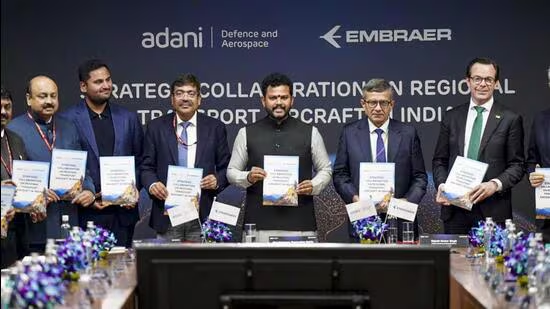
Adani Defence & Aerospace which is part of the Adani Group has teamed up with Brazils Embraer. They signed an agreement to work together on a project. This project is about creating a system in India for transport aircraft. They want to build a place where they can put together Embraer jets in India.
The people in charge made this announcement at an event. Indias civil aviation minister was there too. Both companies said that this deal is a step forward. It is going to help India become self-reliant when it comes to aviation. It will also improve connectivity between regions. They call this idea “Aatmanirbhar” which means India will be able to take care of its aviation needs. Adani Defence & Aerospace and Embraer are excited, about Adani Defence & Aerospace and Embraer working together to make this happen.
1) What the Memorandum of Understanding covers. The things it talks about the important points that everyone is looking at the big items, in the Memorandum of Understanding.
When we look at what the public has been told and what’s in the press releases the MoU is said to be a partnership that will help create a system for regional transport aircraft, in India. The main things that have been made public are:
Collaboration on aircraft manufacturing, including setting up final assembly lines in India for Embraer’s regional aircraft.
Cooperation across the wider ecosystem: supply-chain development, aftermarket services (MRO — maintenance, repair and overhaul), and pilot training.
Public framing of the project as supporting India’s regional connectivity efforts (e.g., UDAN) and India’s domestic manufacturing ambitions (“Make in India” / Aatmanirbhar Aviation).
It is important to note that the MoU is an agreement that shows what the companies want to do and how they will work together but it is not a final deal. The MoU is not the same as a contract that says how things will be done how much money will be spent, where the work will be done or when the first aircraft will be ready.
When talking about the MoU many people and the companies themselves use words like “explore”. Develop” and “collaborate”. This means that there are still things that need to be figured out like the technical details the rules that need to be followed and the business side of things. The MoU is a framework agreement that signals intent and the scope of cooperation, between the companies. It is not a legally binding joint-venture contract.
2) Why Embraer + Adani? Strategic rationale for both sides
For Embraer
India has a big market and it is growing very fast. The market for flying is one of the growing in the whole world. More and more people are traveling within India and to places.
Embraer is building planes in India. This means Embraer is close to the market. Embraer can sell planes. Provide support to customers in India. Embraer also has a partner, in India to help with these things.
Having an assembly can be really good for business and politics. When governments and airlines want things made locally or they want to be able to get parts and help quickly it can be an advantage. Embraer already works with India on defense things. Now they are getting more into the civilian aviation business in India. This is a thing, for Embraer and India because it means they will be working together more closely on civilian aviation projects. Embraer and India will benefit from this assembly.
For Adani
Adani is getting into making aircraft. They already have money in airports and airlines and things that go with that. This means they are now moving into the business of building aircraft and working with high technology in the aerospace sector. So Adani is expanding what they do in aviation, from airports and services to also making aircraft and fixing them which is called MRO for aircraft.
Economic development and skills are very important. The project is a way to create jobs that need special skills build a strong base for companies that make parts for airplanes and make India a center, for the aviation industry. This is what the government wants to happen with economic development and skills.
The deal is also good for India and Brazil because it makes their industries work together closely. This means India is not just relying on the old countries for things like aerospace technology. The India-Brazil deal has a lot of value when we think about diplomacy and strategy. It helps India have friends, in the world of aerospace not just the usual ones.
3) What the final assembly line in India really. What it does not mean. The term final assembly line in India refers to the assembly line in India where products are put together. When we talk about the assembly line in India we are talking about the final assembly line in India. It is the step in making something before it is ready to use. People often get confused about what the final assembly line in India does. The final assembly line in India is not about putting parts together. It is about making sure everything is working properly and that the product is ready to be sold. The final assembly line, in India is a part of making things in India.
So the final assembly of an aircraft is one part of making an airplane. This is when the big pieces like the body of the plane the wings, the tail, the engines and the electronics are all put together. The systems are all. The airplane is finished before it is tested and certified to fly.. When we talk about final assembly it does not mean that every single part of the airplane was made in the same country. There are some things that happen:
* The final assembly of an aircraft is a job
* It involves putting the major components of the aircraft
* This includes things, like the fuselage sections and the wings and the engines and the avionics of the aircraft
* The systems of the aircraft are all integrated during the assembly of the aircraft
* The final assembly of an aircraft happens before the aircraft is tested and certified to fly
* The final assembly of an aircraft does not mean the aircraft is completely made in one country it can have parts from places.
A lot of things and systems will still be made by Tier-1 suppliers from all, around the world. This is because making everything from scratch like engines and avionics suites and composite wingboxes costs a lot of money and takes a time to do. Tier-1 suppliers will keep on making major structures and systems because of this.
A local final assembly line is really good for a place because it creates jobs for people who work on putting things and making sure all the systems work well. It also means that maintenance and repair work can be done locally which is a plus. Some parts of the aircraft like the interior can be made locally too.. When something breaks it can be fixed faster because the people who fix it are close by. The local final assembly line is still good even if some important parts, like engines and special computers have to be brought in from places at first. The local final assembly line is good for MRO and localisation of some subassemblies and interiors and it helps with faster domestic aftermarket support, for the local final assembly line.
So basically we should expect things to happen in stages when it comes to localisation. It will start with things like the Final Assembly Line and local interiors and systems. Then if the supply chain and the skills people have get better we can add local content. Some people, like those, at LiveMint and some analysts are saying that making something at home and getting it certified could take a very long time many years even.
4) Likely timeline — realistic expectations
People who watch the industry and write about it say that it will take years, not months before we see the Embraer regional jet made in India. There are a lot of things that need to happen
We have to pick a site for the plant build it or fix up an old one.
We also have to find companies that can supply us with the things we need and make sure they can do the job.
Then we have to set up places where we can fix and train people to work on the jets.
We need to get the tools for the assembly line and hire people to work on it.
After that we have to train all the staff.
If we make any changes to the Embraer regional jet, for India we have to get it certified again.
This is a lot of work so it will take some time to get everything done for the Embraer jet.
Journalists and analysts think it will take a time like five to ten years to set up production and get a new aircraft variant certified in a new country. This is because there is a lot to do. The Times of India says that if everything goes well we might see the first aircraft roll out in five years.
The LiveMint says that to get everything certified and have a production base it could take up to ten years. Journalists and analysts are talking about aircraft production and certification, in a new country and they think it will take a long time.
Getting a certification for an airplane is a long process. The people who make rules for airplanes want to make sure everything is safe. They need a lot of tests and paperwork to be done. Sometimes they even want the design of the airplane to be changed. This has to be done so that the airplane meets the rules of the country where it will be flying.
Even if Embraer does not make changes to the airplane and it is still the same model they still have to get approval for the new place where the airplane will be made. They also need approval for the people who will be fixing the airplane and teaching others how to fly it. The government will be checking all of these things to make sure they are done correctly.
Here is what Embraer will have to do: first they will make a plan, with someone then they will make a more detailed plan and pick a place to build the airplane. After that they will get everything ready. Pick the people who will supply the parts for the airplane. Then they will build a test airplane. Finally get the certification they need so that the airplane can start flying. The stages are: they will make a plan together then they will make a detailed plan and pick a place then they will build everything and get the parts then they will make a test airplane and finally they will get the certification and the airplane will be ready to fly.
5) Demand calculus — is there a market for regional jets in India?
Indias planes that fly inside the country are usually small. They are like the A320 family and the 737 family. There are also planes with propellers for very short flights.. There are good reasons why a special program, for regional jets can be a good idea:
The government of India is trying to improve connectivity with a plan called UDAN. This plan is very important for India because more and more people from cities want to travel. These people need airplanes that can take them from their cities to bigger cities. The airplanes should have around 70 to 120 seats. This way people from cities can easily travel to bigger cities without having to take smaller planes. Embraer makes airplanes that’re just right for this job. Embraers regional jets are very good, for connecting cities to bigger hubs. The regional jets made by Embraer are what India needs for the UDAN plan.
There are routes that’re longer and thinner. Jets are better than turboprops on these routes that’re around 300 to 800 kilometers long. Many routes in India are like this. Jets are faster. People like them more because they are more comfortable.
As more people start traveling by air these routes will get more popular. People who study these things think that a lot of jets will be needed in the next twenty years. Some people even think that India will need hundreds of these jets in the coming years.
The people who study the industry do not all agree on the numbers. The Economic Times said that India might need, than 500 small jets in the next twenty years. They wrote about how this could be an opportunity.
Demand for these things really depends on how the airlines are doing with money what the airports are like in smaller cities like how long the runways are and if they have good fire services and terminal handling. It also depends on how tickets cost and if the government will help out with money on routes that are not used very much. Embraer and Adani will probably make their sales and assembly goals based on if the airlines, in our country want to buy their planes either by making an order or agreeing to buy them over time.
6) Jobs, skills and the supply chain — potential upside
Having a place where things are put together along with places that fix and train people can bring a lot of good things to the economy. A local final assembly line plus related Maintenance and Repair Operations and training centres can deliver economic benefits to the local community, such, as a local final assembly line and related Maintenance and Repair Operations and training centres.
Direct employment in assembly, testing, quality control, engineering and management.
Indirect employment in supplier firms (interiors, composites, wiring harnesses, avionics assembly, logistics), facilities (ports, roads), and services (catering, cleaning, security).
Developing skills through pilot training and engineering roles is really important for India. This helps make Indias aerospace team stronger, for projects that will happen in the future. Indias aerospace human capital will be better because of this.
The number of jobs that are created really depends on how much of the work is done in the local area. If a company like FAL has to bring in a lot of parts from places then it will not create as many jobs in the area as a company that has many local suppliers. The people, in charge of this project say they want to create a system where many local companies work together to build planes. This means they want to help local companies grow and make things not just put together parts that come from else. To do this they will have to help these local companies get better at what they do share technology with them and give them time to grow.
7) Regulatory and certification hurdles
There are two things that the government watches over and they will be important:
The people in charge of making sure everything is done correctly will need to approve the Final Assembly Line and the people who make the planes. The Directorate General of Civil Aviation in India is the group that needs to say it is okay. They have to approve the Final Assembly Line and the people who make the planes. Embraer already knows how to get approvals from around the world. So Embraer will have to follow the rules of the Directorate General of Civil Aviation or work with them to make sure everything is okay. Embraer will also have to work with the people in Brazil who’re in charge of making sure planes are safe this is important for Embraer because Brazil is where Embraer is from. The Directorate General of Civil Aviation and the people, in Brazil will have to work.
If an aircraft is made in India and it is like the model that has been certified all around the world then the process of getting a certificate can be made easier.. If the people who make the aircraft like Embraer or Adani want to make some changes that are only for the aircraft in India then they have to go through the whole certification process again. This can take a lot of time. Cost a lot of money. The newspaper LiveMint said that getting a certificate for a modified aircraft can take long as ten years for some projects. The certification for a modified aircraft also known as type or variant certification is very important. If the aircraft is not the same, as the one that has been certified then it needs to go through the type or variant certification process.
The regulators will also check the quality systems of the suppliers. They will look at how things can be traced back and the plans for maintenance and training. The standards for the aerospace industry are very high so the people working together cannot take any shortcuts when it comes to quality. This is a thing, for safety but it means things take longer.
8) Financials and commercial structure — the unknowns
People have not been told about the money side of the deal far. This includes how much money is being invested, who owns what part of the company if they are borrowing money if the government is giving them any help and if they will make a company together. The companies are saying that they are working together and trying to build a relationship rather than talking about how much money they are putting in right now. We usually find out more about the details like how the risks and rewards will be shared, when they release documents, such, as the official agreement or contract or after they do some studies to see if the deal is a good idea, which is something that the initial agreement often requires.
People who invest and those who study the market will pay attention to:
I want to know if Adani will own most of the manufacturing company or if they will have an equal share with someone else like a fifty fifty joint venture, with Adani and the other company.
What money is going to be spent on building the plant getting the tools and getting all the necessary certifications for the plant. The company wants to know what the total capital expenditure is for these things, like the plant construction, the tooling and the certification. They need to have an idea of how much money will be spent on the plant construction and also on the tooling and the certification.
The Indian government whether it is the government or the state governments might give some help to companies. This help could be in the form of land or tax breaks or defence offsets. The main goal of this help is to make companies set up shop in India and make things here of getting them from other countries. So the question is, will the Indian central government or the state governments provide these incentives to speed up the process of localisation of companies. The localisation of companies is very important, for the Indian government.
9) Risks and challenges
There is no project to make lots of aerospace things without some problems. The main things that can go wrong with an aerospace industrialisation project include:
India needs to get its supply chain ready. The country has to have a base for making advanced parts like a Tier-1 and Tier-2 system. This is not something that can be done quickly. It will take a time and India will need a well thought out plan for its industries to work together. Building a Tier-1 and Tier-2 base for advanced components is very important, for Indias supply-chain readiness.
The thing, about getting certification is that it can be very complicated. When you need approvals it can take a long time to get everything ready to start using something and this can also make the costs at the beginning a lot higher. Certification is a part of this process and it can be really tough to deal with.
There is a question mark over whether companies will buy these airplanes. Airlines have to promise to buy the airplanes that are put together; if they do not make orders it will not make sense for people to put the airplanes together in this area. This is a problem, for the economics of building airplanes. Airlines need to commit to buying the assembled aircraft or else the whole idea of assembly does not work out.
Capital intensity and execution risk. Aircraft assembly plants and tooling are expensive; schedule slippage and cost overruns are common in aerospace.
The company Embraer has to deal with competition from around the world. Embraer is competing with big companies like Mitsubishi who had a program called Regional Jet. There are also companies in China that are working on projects. If the Embraer plant, in India wants to sell its planes to countries it needs to make sure that its planes are good enough to compete with others. The Embraer plant has to be able to compete with companies if it wants to sell its planes outside of India.
People who study these things are warning that the government and the public will be watching this partnership closely. This means that the partnership between these two companies must be open and honest about how they make decisions the quality of their work and how they keep people safe. The partnership must be transparent, about governance the quality of their work and safety.
10) So how does this fit into Indias plan, for aviation? Indias aviation strategy is really important. This is a part of it. We need to think about how this piece fits into the India aviation strategy. What role does it play in making Indias aviation better?
The partnership is connected to a lot of things that India wants to achieve. It matches up with goals that India already has in place. The partnership is really, about helping India do the things it wants to do.
India is really working on making things at home like the Make in India and Aatmanirbhar Aviation plans.
The country wants to make its defence and aerospace things so it does not have to rely on other countries.
This partnership, between the government and private companies shows that private companies are also working towards this goal of making things in India.
The government wants to connect cities with air services that are good for the environment. This is where UDAN and regional connectivity come in. We need to have our system in place to support smaller planes so we can have UDAN and regional connectivity that really works. This will help the government achieve its goal of connecting cities, with air services that are sustainable. UDAN and regional connectivity are very important for this to happen.
Skills and industrial clusters are really important. In the past big aircraft projects have brought together lots of companies like the people who supply parts the schools that teach people how to work on planes and the places that fix planes. If we can make this happen in India it would be great. India could have its aerospace hub where people make planes not just fix them or make the electronics that go in them. This would be a step forward from what we have now which is mostly just maintenance and avionics firms. India could be a player in the aerospace industry, with its own domestic aerospace hub, where lots of companies, including suppliers, training institutes and MRO all work together.
11) The international situation is very important here. This is why Embraer might decide to choose India at this time. Embraer is a company and it needs to think about what is happening all around the world. So Embraer might think that India is a place to do business with right now. This is because of the context and how it affects Embraer and its business.
There are things about India that make it appealing to people, from other countries. Several international factors make India attractive:
There is a market out there for this and the future looks good. The predictions for growth are really positive especially when you compare them to older markets. The market, for this thing has a lot of potential. The forecasts are favourable.
India has costs that’re good for manufacturing and a lot of talented engineers. This means India is getting better at aerospace engineering. They have engineers now and these engineers have experience, with software and systems and making things.
Embraer is doing something they are making sure they do not put all their eggs in one basket. Embraer is spreading out its manufacturing footprint. Making strong connections with a big emerging market. This can be really valuable for Embraer when there are problems with the supply chain because of politics. Embraer is thinking ahead. This is a good thing, for Embraer.
12) Plausible next steps (what to watch for)
After an MoU, the usual next milestones are:
We need to have agreements for the joint venture formation that clearly say who owns what how much money we will spend, when things need to be done and what each person is responsible for. These agreements are for the joint venture formation. They cover things like ownership of the joint venture the capital expenditures, the timelines, for the joint venture and the responsibilities of the people involved in the joint venture.
We are making an announcement about the site selection. This is where the FAL and the training and maintenance facilities will be. Some people in the press and others, in the industry like to guess which states will be chosen because they have land and policies that make it easy to do business.
Supplier development plans — announcements of tier-1/2 partners, localisation targets and technology transfer commitments.
We need to get announcements or letters of intent from airlines because these things will really help support the business case of the airlines. The airlines will give us these announcements or letters of intent. That will back up the whole business case, for the airlines.
Regulatory filings with DGCA / ANAC about approvals.
Ground-breaking and construction of facilities.
When you are following the story you should look out for the Joint Venture documents and the incentives that the state government is offering. These things usually mean that the project is going from an idea to actually happening. The firm Joint Venture documents and the state government incentives are signs that the project is moving forward.
13) Bottom line — significance and realistic expectations
The Adani–Embraer MoU is really important for a couple of reasons. It is a deal that one of the best companies in the world that makes regional jets is teaming up with a big Indian company that already does a lot of things like run airports, logistics and energy. This is an example of how different parts of a business can work together. The Adani–Embraer MoU shows that they are very serious about making India better at putting and supporting regional jets. They also want to build a system for the aerospace industry that includes teaching people new skills and doing maintenance and repair work. The Adani–Embraer MoU is a step, towards making this happen.
The thing is, a Memorandum of Understanding does not mean production will start tomorrow. If you look at the information that’s available to the public you can see that the partnership is still in the planning stage. They are just exploring ideas now.
To actually make a Final Assembly Line that helps the country make its things and especially to make sure the important parts of the planes are made locally this will take a long time. We are talking about years maybe even ten years or more.
The companies will have to get approval from the government. They will have to find suppliers and get commitments from airlines to buy the planes.
People who know about the industry are saying that we should not expect much to happen right away but they also think that this could be really good, in the long term. The partnership is a Memorandum of Understanding. This is just the beginning. The Memorandum of Understanding is not a guarantee that production will start soon.
If the project is done well the project could do a lot of things like the project could make a big difference and the project could be very successful.
* The project would be able to help people in ways and the project would be a great thing to have.
1. The project is something that a lot of people are going to be using so the project needs to be good.
The project has to be done so that the project turns out well and the project does what it is supposed to do which is make the project a success.
Improve regional connectivity with modern jets,
Create skilled aerospace jobs,
We need to help India move forward and become a player in global aviation supply chains. This means India should be doing high value work in global aviation supply chains. India moving up the value chain in aviation supply chains is very important for India. India has to improve its position in aviation supply chains. Helping India do this will be very good for India. India will get benefits when India moves up the value chain, in global aviation supply chains.
If execution stalls or commercial orders do not materialise, the project could remain an aspirational headline without major industrial impact. The coming 12–24 months should reveal much about whether this MoU is a signalling exercise or the first formal step toward a functioning Indian aerospace manufacturing hub.