Changes in medical education — India plans to open new medical colleges and increase MBBS seats in 2026 with updated fee structures.

India’s medical education system is going through a big “capacity expansion + tighter process + revised charges” phase, with the 2026-27 academic year shaping up to be an important check post. Quite simply, the headline idea is this-more medical colleges, more MBBS seats, and more structured, costlier approval processes are in place, with the regulator also pushing for better documentation, greater transparency, and minimum standards.
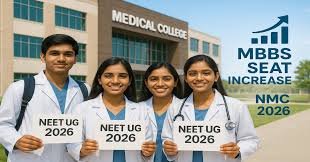
Below is a detailed, student-friendly explanation of what’s changing, why it’s happening, and what it could mean for MBBS aspirants in 2026.
1) What is this “2026 plan” everyone’s talking about?
In late December 2025, the National Medical Commission issued a notice inviting online applications for two things for AY 2026–27:
Establishment of new medical colleges who are desirous to start the MBBS undergraduate courses.
Increase the number of seats for MBBS (UG intake expansion) in already established colleges.
According to the reporting, the application window will be from December 29, 2025 to January 28, 2026, and everything is online; no offline submissions are allowed.
This is the reason why news reports say, “India plans to open new medical colleges and increase MBBS seats in 2026”—because the approval cycle for 2026–27 is being formally opened and systematized.
2) Why is India expanding medical colleges and MBBS seats?
A. Physicians demand + healthcare access
Over the years, India has been trying to expand the doctor pipeline because of increasing demand for healthcare due to:
population growth and ageing,
higher burden of non-communicable diseases (diabetes, heart disease),
Need for doctors in smaller cities/districts.
Stronger post-pandemic public health infrastructure.
Medical seats are the “raw material” for future doctors. If more doctors need to be provided, MBBS seats and adequate clinical training capacity should be increased correspondingly.
(B) An announced government drive: “10,000 next year, 75,000 in five years”
The government has publicly projected a large seat expansion. For instance, Budget-related reporting has noted an aim to add 10,000 additional seats in the next year, and 75,000 seats over the next five years.
(C) Cabinet approval to add 10,000+ seats in government colleges [existing institutions]
One PIB release by the government described the initiative approved by the Cabinet to add more than 10,000 new medical seats across existing government colleges/hospitals, with a funding plan spread over several years.
Press Information Bureau
So, the 2026–27 NMC application notice fits into this larger direction: expand capacity but under a tighter regulation and minimum standards.
3) What changes is it that the 2026–27 NMC/MARB notice is highlighting?
Change 1: A more transparent, portal-driven application process
The notice then emphasizes that
only online applications, and
Integration of login/registration with official email IDs [as existing colleges are using only NMC-registered email]
This matters because NMC has been working its way towards a more standardized and trackable system wherein every college would have an auditable trail of submissions, fees, documents, inspections, and approvals.
Change 2: Temporary relaxation (abeyance) of a seat-cap provision—BUT with conditions
A key line reported is that for AY 2026–27, MARB has kept in abeyance a provision of the UG Medical Education MSR, 2023, relating to the cap/limits for seat increases.
www.ndtv.com
However, that same reporting also notes guardrails such as:
The total intake for MBBS should not be more than 150 students per college, as referred to in the report, and
a population-linked guideline such as 100 MBBS seats per 10 lakh population in the State/UT is referred.
or in other words:
They are trying to make expansion possible, but
They still want it to align with capacity and planning norms, not uncontrolled growth.
Change 3: Updated “fee structure” — important clarification
Many headlines will carry “fee structure changed,” and in the minds of people, it is about MBBS tuition fees. For this notice cycle of 2026–27, the revision that was highly reported was just about the NMC/MARB application-processing fees for approvals (institutions pay to apply for permissions) and their related compliance costs such as bank guarantees/security deposits, not the annual tuition fee that one pays as a student.
The student tuition fees are another (yet related) debate—on that, some other time.
4) Approval/Application fees revision: What’s being told?
A variety of reports point out a major increase-approximately 50%+ of the charges for:
applying to open a new medical college and
Both have applied to increase MBBS seats.
They also mention the existence of different fee structures for government and private institutions separately; a number of processes were more uniform earlier.
(A) Non-refundable registration/application fee
Reporting mentions a non-refundable registration fee of ₹2 lakh. It is also mentioned that it can be kept different for UG/PG applications.
(B) Processing fees – Government vs Private; seat-based slabs
One report gives the following typical ranges:
Government Institutions: approximately ₹ 6.2 lakh to ₹18.7 lakh + GST depending upon seats.
Private institutions: approximately ₹7.5 lakh to ₹22.5 lakh + GST, depending on seats.
(C) Fees solely for seat expansion (a significant “new/ explicit” fee)
Reports highlight that expansion of seats is charged, figures like:
₹7.5 lakh (private)
₹6.2 lakh – government
(D) Bank guarantees / security deposits: the “performance guarantee” layer
Another highly debated section is the necessity for a single-performance electronic bank guarantee, the tenure of which is stated as 6 years, with large amounts tied to seat capacity. Reported figures include:
₹15 crore for a 50-seat college
Rs 20 crore for 100 seats (or additional 50 seats in some cases)
₹25 crore for 150 seats
and an additional ₹5 crore for some “additional 50 seats”.
Medical Dialogues
These numbers are large on purpose. The idea behind this is:
in case a college promises infrastructure, faculty, hospital tie-ups, labs, hostels, patient load, etc.
the regulator wants financial “skin in the game” to discourage paper-only colleges and ensure continuity/quality.
(E) Tightening up disclosure and documentation
Reporting also mentions requirements such as declaration of other colleges run by the trust/society across states, besides enhanced documentation and transparency requirements.
5) For what reasons would NMC increase application/processing fees and guarantees?
From a policy perspective, there are a few reasons:
(1) Quality Control in Fast-expansion Era
The big fear when you expand MBBS seats in quick time is dilution:
too few faculty,
Not enough patients/clinical exposure.
lack of laboratories, cadavers, skills labs
inadequate hostels and teaching facilities.
Greater compliance costs + structured evaluation serve as a filter against weak proposals.
- Funding the inspections, assessments, and monitoring
A more rigorous system requires:
inspectors,
Digital audits.
site visits,
Follow-up assessments.
The fee structure of a regulator is another way to fund the machinery of regulation.
(3) Deter “speculative” applications
If filing is inexpensive, many entities file without serious preparation, expecting to “make it work later.” Higher fees and bonds reduce filings made with speculative intent.
6) How is that related to what students pay- MBBS tuition fees?
This is where many people get confused, so let’s separate the two:
A) NMC/MARB “fee structure” in this news cycle
Mainly, this is about:
application/processing fees paid by institutions and
Compliance instruments such as bank guarantees.
B) Student tuition fee regulation-a parallel policy debate that is continuing
Separately, under the NMC Act, 2019, there is a provision for guidelines to determine fees and other charges for 50% of seats in private medical institutions and deemed universities—often described in public discourse as “50% seats at government-level fees.
The challenge is that implementation varied by state and institution type, and it’s also an area where there is some legal and policy friction.
And so, with “updated fee structures,” you might be looking at:
Application/processing fees for colleges, and/or what the December 2025 notice is strongly about.
student tuition regulation debates 50% seat fee guidelines, state fee regulating authorities, etc.
Discussion between doctors
- What does MBBS seat expansion mean for NEET aspirants in 2026?
(A) More seats generally improves odds—but not evenly
More MBBS seats can:
slightly reduce pressure in some states.
create opportunities in under-privileged districts;
This may eventually lessen the number of students going abroad for an MBBS course.
But it’s not the same benefit:
Seats may grow more quickly in some states than others.
New colleges take time to reach full quality or clinical maturity.
(B) Counseling complexity rises
More colleges and seat variations mean
more options,
This, in turn, has created more confusion about new institutions’ hospital load, faculty strength, and teaching quality.
For students, the strategy will increasingly involve:
verification of NMC recognition status,
assessment of bed strength and patient load of the hospitals.
This will be based on previous academic performance, when available.
(If you wish, please just share your state and category, I will be happy to help you by sharing a practical checklist which will come in handy for you during counseling to evaluate the new/private colleges.
8) Merits and demerits of rapid establishment of a large number of new medical colleges
Advantages
1) Access and Equity: This can reduce the geographic inequality in medical education and health care because of the spread of new colleges across smaller cities.
2) Local health boost: Medical colleges tend to become anchors for district healthcare.
- Workforce pipeline: Assists in the long-term availability of doctors. 4) Less “seat scarcity premium”: In theory, more seats can reduce extreme pricing power in the education market. Risks/Concerns 1) Quality Dilution: Seats without sufficient faculty/patients dilute training. 2) Faculty shortage: There is a need to expand seats in parallel with the increase of qualified teachers. 3. Clinical exposure: If hospitals are not getting adequate patient flow and are attached to colleges, hands-on learning for students suffers. 4. Cost pressures: If the cost of compliance for colleges increases-fees, guarantees, infrastructure-private colleges may look to recover costs through increased charges where possible, so that affordability would be a live concern. This is why regulators focus a great deal on MSR compliance and inspections. 9) The concept of a “population-based ratio” and what it entails The report referring to 100 MBBS seats per 10 lakh population suggests a planning approach that roughly the seat growth should match the population needs and distribution. www.ndtv.com It could mean, in practice: States with lower seat density may favor more rapid expansion. Limits could be even more restricted for those states that are already saturated. That might influence the location of newly accredited colleges. 10) Take home message (plainly stated summary) For the AY 2026–27, India is pushing medical education expansion through a regulated pipeline: New medical colleges+MBBS seat increases are being opened for applications via NMC/MARB. Times of India +1 The application window reported is Dec 29, 2025 to Jan 28, 2026. www.ndtv.com Temporary relaxation of MSR-related seat cap provisions is indicated, with conditions like total intake limits and population ratio. www.ndtv.com This much-discussed “updated fee structure” is allegedly mainly composed of approval/application-related fees that have risen steeply and are separate for government versus private, plus added seat-expansion charges. Times of India +1 Large bank guarantees/security deposits are part of the compliance design to enforce seriousness and quality. The Medical Dialogues This fits into a broader national push for tens of thousands of additional medical seats over the coming years.