Escorts Kubota rolls out tractor for paddy crop as it sharpens focus on south India
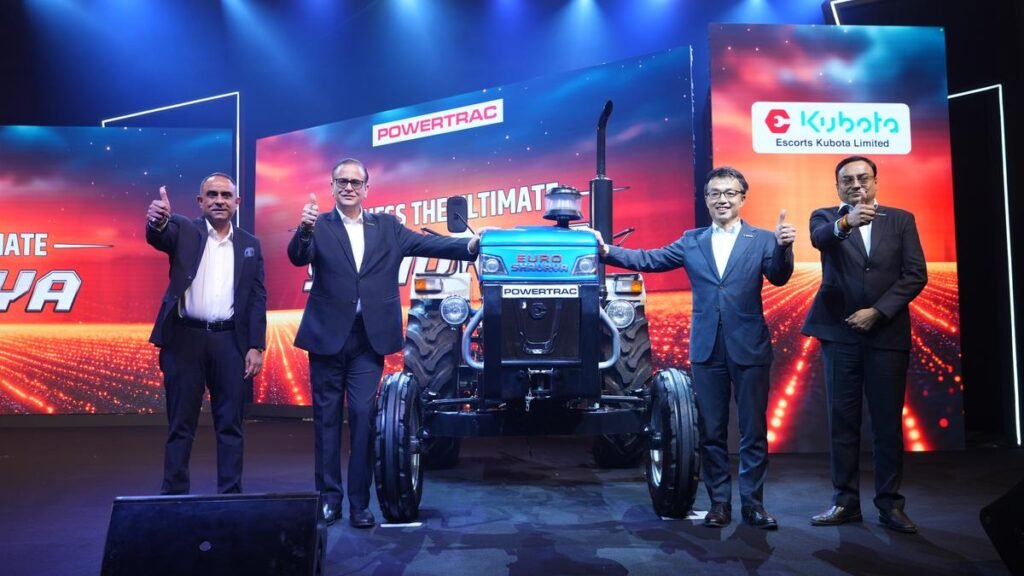
Escorts Kubota Limited has launched a tractor series, called Powertrac Shaurya specifically designed for paddy farming in southern India. This series is a “South Special” paddy tractor range, created to meet the needs of wetland and paddy-field operations in rice-growing states like Telangana, Andhra Pradesh, Tamil Nadu and Karnataka.
Here are the key features of the Powertrac Shaurya series:
* The series includes five variants with horsepower ranging from 39 to 52 HP.
* The tractors are designed to operate in waterlogged conditions with features like cassette-type sealing to prevent water and mud ingress.
* They have a turning radius of around 3.1 meters making it easier to maneuver in small fields.
The company claims that this tractor series can help farmers with reliability, productivity and lower maintenance costs. Paddy farming presents challenges, such as working in wet and flooded conditions and requires tractors that can handle these conditions.
The launch of this series is part of Escorts Kubotas strategy to expand its presence in the Indian market. The company has announced investments in manufacturing facilities, which will help increase production and meet growing demand.
The new tractor series is expected to have benefits for farmers, including:
* Lower downtime and maintenance costs
* Higher effective productivity due to headland turns and better matching with paddy implements
* Improved yields due to mechanized puddling and transplanting
The series is also expected to have an impact on the dealer network and after-sales service. Escorts Kubota will need to ensure that its dealers are trained to provide service and support to farmers.
In terms of market implications the launch of the Powertrac Shaurya series is seen as a move by Escorts Kubota to gain market share in southern India. The company is competing with established players like Mahindra, TAFE and Swaraj. Its focus on paddy farming and wetland operations could give it an edge.
The tractor market in India is highly competitive. Escorts Kubotas success will depend on how well its product compares to others in terms of reliability, fuel efficiency, operator comfort, price and serviceability.
The launch of the Powertrac Shaurya series also reflects Escorts Kubotas strategy to grow its business and expand its manufacturing capacity. The company has announced investments in new manufacturing facilities, which will help it meet growing demand and increase its exports.
Overall the launch of the Powertrac Shaurya series is a development in the Indian tractor market and it will be interesting to see how it performs in the coming months and years.
The Shaurya launch aligns with a growth and manufacturing pivot by the company. Escorts Kubota has signalled investment into manufacturing capacity.
The Shaurya series emphasizes engineering and operator comforts. From press coverage and the company release the Shaurya series emphasizes sealing and ingress protection.
Those are the verifiable points. The product rollout sits alongside Escorts Kubota’s capacity and investment moves.
Escorts Kubota unveiled the Powertrac Shaurya series. The line comprises variants spanning roughly the 39–52 HP bracket.
Rice cultivation presents machine demands compared with upland or dryland crops. Paddy fields are often intentionally flooded; tractors must tolerate exposure to water, slurry and corrosive conditions.
Manoeuvrability in plots. Indian paddy farms often have smaller irregular plots. A short turning radius reduces the need for reversing or wider turns improving work rate and reducing crop trampling.
The company positioned this as the Powertrac brand’s dedicated wetland/paddy-focused series targeted at major southern rice belts.
Key product claims called out by the company. A five-variant range across the 39–52 HP category. Engineering focused on wetland durability.
The launch explicitly targets the rice-producing states. Regions with a mix of cultivated irrigated rice systems and a high level of mechanization potential.
Mechanization intensity. Pockets of India already show high mechanization in rice. A dedicated product can accelerate tractor adoption.
Crop and plot structure. Many to-medium-sized plots demand nimble tractors. Southern states’ cropping patterns also place a premium on tractors that can transition between dry tasks.
Dealer. Aftermarket. The southern states also have a dealer and after-sales ecosystem for agri-machinery.
The focused regional approach. Tailored solutions often sell better than one-size-fits-all tractors.
Farmers. Lower downtime and maintenance costs. Higher effective productivity.
Affordability. Adoption depends on financing options and the total cost of ownership.
After-sales. Parts and service demand. New model lines increase demand for spares, training and specialized service routines.
Company / Industry. Market share potential. The paddy segment in India is large; a successful region-specific model can grow market share.
Brand positioning. The launch helps position Powertrac as responsive to crop needs.
The Shaurya launch aligns with a growth and manufacturing pivot by the company. Escorts Kubota has signalled investment into manufacturing capacity.
The tractor market in India is crowded and competitive. Key points. Incumbents. Mahindra, TAFE and Swaraj / Sonalika have dealer networks.
Niche specialists. Some companies and smaller brands have targeted paddy/wetland tractors.
Product differentiation. Success will hinge on how the Shaurya compares on reliability, fuel efficiency, operator comfort, price and serviceability.
Complementary offerings. Escorts Kubota has previously launched rice transplanters.
The Shaurya launch aligns with a growth and manufacturing pivot by the company. Escorts Kubota has signalled investment into manufacturing capacity.
From a finance perspective such capital spending must be balanced against cyclical rural demand.
Economic and social effects. Labour dynamics. Continued mechanization reduces reliance on transplanting and puddling labour.
Timeliness. Mechanized puddling and transplanting done in the window can improve establishment and yields.
Rental market growth. A paddy-specialized tractor could be an asset, for rental operators.
Aftermarket Industry Growth
More tractors made for tasks are increasing the need for machines and services that work well with rice farming. This helps economies near tractor dealerships and service centers.
#. Constraints
Price Sensitivity: Farmers care about prices. If our Shaurya tractors cost much without clear benefits farmers might not buy them.
Dealer Execution: If tractor dealers aren’t ready it can hurt our reputation. We need trained dealers and spare parts available.
Competition: Other companies might copy our tractors or offer fixes; we must keep our technology and service ahead.
Rural Demand: Tractor demand depends on incomes, crop prices and credit. Economic problems can slow sales.
Supply Chain: Problems with getting parts and materials can delay tractor deliveries.
# What Success Looks Like
Sales in Target States: If we sell well in Telangana, Andhra Pradesh, Tamil Nadu and Karnataka it’s a sign.
Rental and Custom-Hire: If rental centers adopt our tractors it’s a sign many small farmers will use them.
After-Sales: If our tractors have problems and less downtime it means our design works.
Dealer Satisfaction: Happy dealers with part delivery are crucial.
Pricing and Finance: We need to track how many sales are financed and compare our prices to others.
# Strategic Recommendations
# For Escorts Kubota
* Train dealers well. Stock up on spare parts in southern markets for a year.
* Offer financing and packages for operators to help small farmers.
* Share stories of farmers who use our tractors successfully.
# For Dealers
* Host events to show off tractors during planting seasons.
* Offer deals for small farmers to try our tractors.
# For Farmers/Custom-Hire Operators
* Think about the cost of owning a tractor over several years.
* Consider renting a tractor before buying.
# For Policymakers and Agri-Extension
* Support centers that help farmers get equipment and train operators and mechanics.
# Broader Takeaways
The launch of our tractors is an example of a global strategy, with local focus. We are using engineering to gain market share. Success depends on the chain: finance, service, parts and dealer competence. If we succeed it could help mechanize farming in India affecting labor, productivity and local economies.