Flying spy? seagull with made in China GPS tracker found on Karnataka beach; sparks buzz
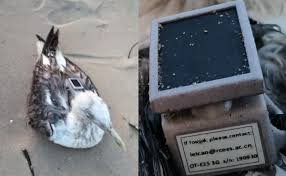
“Spy bird” was the headlines on social media in Karnataka last week after residents noticed a seagull was spotted with a small GPS tracker that had “Made in China” written on the packet. This was noticed along the Karwar coast in the Uttara Kannada district—a region that tends to see more action since it borders the INS Kadamba / Project Seabird, which is one of the biggest naval bases in the country.
But as officials intervened, it all became much less exciting—and much more telling about research on wildlife, reasons why “China” is a suspicious flag, and the spread of misinformation when tech and geopolitics collide.
Following is a detailed description in context of what occurred, reasons behind the controversy it generated, and what it actually reveals.
1) What actually occurred on this Karnataka beach?
The Discovery
According to reports, the matter came to light when residents spotted the seagull resting in the area of the beach in Karwar with an object tied to its body. In some versions of the story, the bird appeared to be tired and had some bruises on its body, which led authorities to speculate that the bird had been grounded after flying long distances or after experiencing harsh weathers.
Why it appeared “suspicious” right away
This object was visible and definitely not natural – more like a kind of tracker or a tag. But the actual trigger for increased tension was the labeling on the object – “Made in China.” This had the effect of a match stick on dry grass – people went from “GPS tag” to “espionage” in a flash, particularly since Karwar is a strategic coastline area.
The
Authorities began searching, and both forest/wildlife departments and security forces/police were said to have been involved, primarily because:
the location is sensitive, and
Any unclassified device on a projectile (or even a bird) triggers conventional security concerns.
2) Why Karwar (and INS Kadamba) makes people extra alert
Karwar is not an ordinary beach town. It is also linked to INS Kadamba / Project Seabird, which is an important base for the Indian Navy. The development of naval bases, especially along the coasts, has tremendous importance, and an apparently normal incident, such as a tagged bird, becomes a big news story if it takes place in a naval area.
The inclusion of “near a naval base” in the equation is what caused the initial rescue of wild animals to turn potentially more serious, since fears existed that the bird might have flown over areas such as restricted zones, ports, docks, and patrol routes that are not seen by average citizens but might be areas of interest to adversaries.
3) What the officials said: Research first, not spying
After scrutinizing the device, there circulated multiple reports that came to the same crucial point about
Preliminary indications were that it related to scientific research, namely tracking animals, and was in no way related to spying.
Certain reporting referred to the marks being linked to a Chinese research organization (citing connections to the Chinese Academy of Sciences or an associated institute), which fits the model associated with studying migration patterns and behavior, as with certain academic labeling systems.
This does not, however, imply that “the file was closed.” It simply reflects that the most probable usage, according to the device and identifiers, was tracking.
4) Why might a seagull have a GPS tracking device?
This is the most significant part of the background information, and it is also where public perception tends to trail currently available scientific knowledge.
Wildlife GPS tracking collars are fairly common
Scientists attach bird-tracking devises to solve queries such as:
What are the migration routes?
What are the seasonal routes they take?
Where do they eat and rest?
In what ways do storms, winds, pollution, or climatic changes affect the movement?
Which habitats are most important to conserve?
For example, in the case of migratory animals, tracking is one of the most effective techniques that are currently available to us, since their journey involves thousands of kilometers and international boundaries, sometimes even crossing different countries and different oceans.
What does a bird tracker look like in general?
A standard tracking configuration can consist of:
a small GPS unit,
An ID label or code,
sometimes sensors (temperature, altitude, acceleration),
and a transmitter system (for transmitting data through satellites or cellular phones, depending on design).
Such units tend to be designed to be as light as possible and optimized to avoid drag as well as discomfort.
“Made in China” does not necessarily mean “Owned by China”
The truth is that many of the components and hardware involved in such projects are made in China, even if it is an initiative of scientists in other locations. A symbol of origin is not necessarily a validation of who is sponsoring and who is running it.
Still, in this particular case, there were reports of marks on this device that were associated with some Chinese research institutions, which indirectly indicates that the device is being used for academic purposes rather than spying because there are indeed tracking projects undertaken by wildlife institutes around the world that are published.
5) Why did “spy rumours” burst forth so suddenly?
Because the story occupies the space at the intersection of a number of genres and themes
visible technology (a device attached to a bird),
external factors like geopolitical tension (public perception of suspicion between India and China),
a sensitive location (naval zone).
Now, with social media thrown into this equation, rumors become “facts” in minutes.
The Psychology of a Viral Suspicion
Suposición
“When individuals are exposed to something novel, the brain searches for a pattern:”
A tracker on a bird is equivalent to saying “someone is tracking something.”
Location = “naval zone.”
Label = “China.”
Conclusion = “spying.”
The leap feels justified emotionally, even if it isn’t so intellectually.
The role of “mystery tech”
By this
Most people will not be familiar with the existence of wildlife research equipment. Therefore, a GPS device looks no less than a spying tool if there is no public awareness program to disseminate information regarding the tag system.
6) Could birds be employed for spying in theory?
It is only right to pose such a question since animal “spying” tales have long been going around the world. In theory, for sure, animals can carry devices like cameras, transmitters, and so on.
However, this poses enormous practical difficulties, and that is where most “spy birds” fail.
Why a Seagull is Not a Good Spy Platform
A bird may
Unpredictable motion: You don’t see birds flying on command. They follow food, weather, and instincts.
Data Reliability
“Even if a device captures a piece of information, it is quite hard to reliably recover or transmit that information,” Farz
Operational control: A spy net must provide repetitious routes and collections.
Risk of visibility: A burdened device is visible and detectable (as in the case at hand).
On the other hand, the current era of espionage requires the following:
satellites,
drones,
cyber tools,
signal intelligence,
human intelligence.
In most practical cases, GPS-tracking a seagull has been found to be poor compared to other techniques.
Thus, yes, “animal spying” may be possible in theory, although in this case, there appeared to be research rather than spying at play, at least initially.
7) Why would a research-tagged bird end up on a Karnataka beach?
This is normal when monitoring projects.
This is
A migratory bird may arrive at any point on the route due to the following reasons:
storms and headwinds
exhaustion,
injury,
food availability,
navigational deviations,
human disturbances (lighting, noise, pollution),
seasonal changes.
When an identifiable bird rests on a beach, it attracts more human attention because:
“The beaches are open public spaces,”
birds are visible,
and a shiny device catches attention.
8) Actions that are normally taken by those in authority during incidents
Although the likely cause is “research,” it is still a situation that must be treated with care—not to mention around sensitive sites.
A responsible response will typically involve:
Rescue and welfare check of the bird. Bird injury assessment and handling.
Analyze the tag for identification marks, series numbers, institute names, frequency bands, SIM details if any, and so on.
liaise with the relevant bodies for the project validation and tagging of ownership of the project in the context of the
If required, engage security forces to check whether your device isn’t collecting any forbidden data.
Action plan/to do list:
• Return the bird to the natural environment (if it appears healthy).
• Hand it over to the treatment/rehabilitation center (if the bird is injured).
“This process isn’t ‘paranoia’—it’s due diligence,”
9) The “China angle”: why it matters, and why it can mislead
Notably, this particular instance became a topic of discussion in large part because it involved a “Chinese-made” device or those related to Chinese researchers.
Two things might be true simultaneously:
People have every reason to exercise care around military facilities.
Wildlife tracking is an honest international scientific activity, and the involvement of Chinese institutions (like most international institutions) is justified.
Evidence is the key. GPS tracking devices are not necessarily spy devices. Here are the important things:
what sensors it has,
“what data it stores/transmits”,
- the destination of the information (if it sends information),
and who controls it.
That is why they look at the technical specifications of the device, not at what is generally speculated in the public domain.
10) Reasons why this story is relevant: “tech anxiety” and “security anxiety”
Technical anxiety
Tech
“We’re all worried about tracking: our phones, our apps, our cameras, our AI,” applies to all of us. “So when you think about it on a bird, it
Security anxiety
Coastal areas and military stations are always sensitive issues in India, and people are aware of security threats. Add “China” to it, and it becomes emotionally automatic.
This is how a small detail on a bird becomes a big story: it allows two big fears to come together.
11) What you can learn from this experience
1) Studying wild life: it’s everywhere
There’s an increasing use of sensors, tags, and data in conservation and ecology. Research into bird migrations can be international in scope, as sometimes birds with tracking devices appear in unexpected places.
2) “Made in China” is not a conclusion
This is just a detail, sometimes significant and sometimes insignificant. By itself, the fact of manufacture is an inadequate mark of
“3. Caution is necessary—panic is not”
Testing the device is reasonable. Claiming “spy bird caught” when there is no evidence is not.
4) Media Literacy is Important
“If a story makes you instantly angry or afraid, it is definitely worth taking a step back and wondering about the following questions: Who confirmed it? The claims that were being made by the Are there other explanations that fit the facts, like research? In this case, there were reports emphasizing the initial suggestions that the monitoring was scientific in nature and not spying. The Economic Times +2 Telegraph India +2 12) The bigger picture: responsible talk about these stories. “If you are sharing a story like that (particularly as a form of content creation, which you are clearly interested in), a proper structure for that story would be:” History records that what actually occurred involved the Why it looked suspicious (public reaction) What officials found: How the technology works ( education ) What remains unknown (if anything) What not to assume (avoiding sensationalism) This kind of presentation technique earns your listeners’ trust and also enables them to gain something authentic, not a mere reaction.