Trump’s Iran Strikes Usher In an Era of Unrestrained American Power
The phrase “Trump’s Iran strikes usher in an era of American power” shows a big change in how the United States uses military force.
It also shows how the U.S. Defines its leadership and balances power with legal and diplomatic limits.
The recent military campaign ordered by U.S. President Donald Trump against Iran is one of the important geopolitical events of the 21st century.
This is because of the scale and targets of the operation.
It also shows how America is willing to act and decisively without traditional restraints.
In this environment American power seems less limited by international law, alliances or domestic politics.
This marks a turning point in politics.
To understand why analysts say these strikes signal an era of “American power we need to look at the military actions.
We also need to consider the politics behind them comparisons with earlier U.S. Wars and the debates they sparked.
We must also think about their impact on global order, diplomacy and future conflicts.
The immediate trigger for this perception was the scale and ambition of the U.S.–Israel military campaign against Iran.
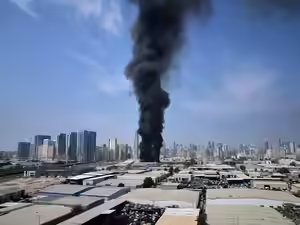
The operation involved hundreds of aircraft, cruise missiles and drone systems.
They struck hundreds of targets across Iran, including missile bases and military headquarters.
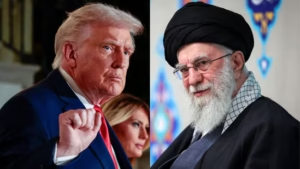
The strikes also reportedly killed Iran’s Supreme Leader Ayatollah Ali Khamenei and several senior military commanders.
This act removed the head of a state’s political and religious leadership.
Historically the U.S. Avoided killing the top leader of another major regional power.
This was due to the risks of escalation.
This strike showed that Washington is now willing to take that risk if it believes its strategic interests require it.
President Trump said the strikes were necessary to prevent Tehran from acquiring weapons and expanding its missile capabilities.
This justification reflects a doctrine of preemptive warfare.
Preventive war is controversial under law.
It allows powerful countries to attack ones based on perceived risks rather than actual aggression.
The strikes against Iran echo the logic of the 2003 U.S. Invasion of Iraq.
However unlike Iraq the Iran operation relied on airpower, missiles and drones.
Another key reason analysts describe the strikes as ushering in American power is the U.S. Willingness to act without broad international approval.
Many countries, including Russia condemned the strikes.
The United Nations held emergency sessions.
This reflects the seriousness of the escalation.
Traditionally major U.S. Military interventions were carried out with coalitions and UN support.
The Iran strikes appear to have been driven primarily by U.S. And Israeli strategic calculations.
Domestic politics in the U.S. Further reinforced this perception.
Many lawmakers from both parties criticized Trump for launching the strikes without authorization.
Critics described the strikes as acts of war.
They warned they could draw the country into another conflict.
The strikes also show how advances in technology have transformed American power.
The U.S. Can now launch precision strikes anywhere in the world.
These technologies allow Washington to project power quickly and decisively while minimizing casualties.
The broader strategic goal suggested by Trump’s rhetoric also contributes to the perception of American power.
After the strikes he urged the people to overthrow their government.
Regime change has been an element of U.S. Foreign policy.
These interventions often produced long-term instability.
However the reality of power remains complex.
While the U.S. Can inflict military damage it cannot fully control the political consequences.
Iran responded with missile and drone attacks on U.S. Bases across the Middle East.
U.S. Officials acknowledged that achieving long-term objectives would take time.
Historically American power has gone through phases.
After World War II the U.S. Emerged as the global power but often acted within alliances.
During the Cold War U.S. Actions were constrained by the risk of war with the Soviet Union.
After the Cold War ended the U.S. Became the world’s superpower.
The strikes against Iran suggest a departure from the approach of the past.
Of avoiding escalation the U.S. Directly targeted the leadership and core military infrastructure of a major regional power.
The psychological and symbolic impact of the strikes is also important.
By demonstrating that it could eliminate one of its powerful adversaries’ top leaders the U.S. Sent a message to Iran and the world.
Allies may see the U.S. As a decisive protector while adversaries may view it as more dangerous and unpredictable.
This perception can reshape alliances, deterrence strategies and diplomatic negotiations.
The strikes raise ethical and legal questions.
International law generally prohibits the use of force against states except in self-defense or with UN authorization.
Critics argue that preventive strikes based on perceived threats undermine the framework designed to prevent war.
Domestically bypassing Congress raises concerns about accountability.
Economically military escalation with Iran also carries consequences.
The Middle East is a source of oil and conflict in the region can disrupt energy supplies.
Military tensions can also influence markets, trade routes and investment decisions.
The impact of the strikes extends beyond the battlefield.
The strikes ordered by President Trump against Iran represent a defining moment in geopolitics.
They demonstrate the U.S.’ ability to project military power.
They also reflect advances that make military action easier and less risky for American forces.
At the time the strikes highlight the limits of military power.
The phrase “usher, in an era of American power” captures the idea that the U.S. Is increasingly willing to use its military dominance aggressively and independently.
This could define relations for decades to come.