UP road accident: several buses catch fire on Delhi-Agra expressway after collision ; 4 killed
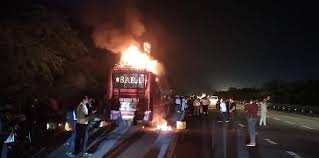
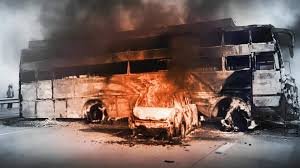
In the wee hours of Tuesday, the 16th of December 2025, a chain-reaction accident in the Delhi-Agra Expressway, also known as the Yamuna Expressway in the Mathura district of the state of Uttar Pradesh, turned into a massive fire accident as several buses and a few vehicles collided with each other due to thick fog, with some vehicles catching fire. According to initial reports from the major news channels, at least 4 people were killed and 25 injured.
What happened: The sequence in simple terms
Reports suggest this was a multi-vehicle pileup and not a two-vehicle crash. Also, in thick winter fog, drivers might see nothing in front of them for a few meters. When traffic is moving at a high rate on the expressway and the vehicle ahead brakes or slows down or is already stopped, the following vehicles might not have time/reaction time. “One accident becomes a chain reaction as the second car strikes the first one, the third car strikes the second car, and on and on, often with multiple large trucks such as buses on the highway.” In this case, at least 7 buses and 3 cars were involved in this pileup crash, or a total of 10-11 vehicles, depending on the report.
Why it became a fire tragedy (not “just” a crash)
Among the many factors that made
The incident has left a deep mark on all of us as it is not simply a case of vehicles meeting in a crash; rather, it has turned into a scenario involving a fire and rescue operation. This is simply because when a number of large vehicles crash at high speeds, a variety of factors may come into play in triggering a
Leaks of fuel + heat/friction: Damage from the impact could cause the fuel line or tank to rupture, or sparks or heated surfaces could ignite fuel vapors.
Compressed Crowding: In a pile-up, automobiles are packed closely together; once a fire breaks out in an automobile, it can easily spread to other automobiles nearby.
Furniture and interior elements of buses catch fire quickly. These include seats, curtains, plastics, foams, wire strips, and passenger baggage.
Blocked exits and panic: Survivors estimate that they have seconds to get out, but blocked doors and windows, broken glass, and panic will prevent many from escaping.
Topics include:
This explains why there were reports that a number of buses were on fire, as well as the fact that the death toll included persons caught up in the fire.
La présence de brouillards (et la visibilité, facteur de risque
There have been numerous instances where the accident has been traced to dense fog and poor visibilities, a typical condition in North India during the month of December mornings. Dense fog is dangerous because you have poor visibilities. However, what is even worse is that:
Speed
(Customarily, you believe that you’re moving more quickly than in actuality
The car in front appears to be further away – Distance
Braking time (reaction time is longer when you’re uncertain about what you’re seeing)
In case of expressways, the risk is manifold since, in this case, cars are designed for higher speeds, and if there’s a slight pause before applying the breaks, the crash will be quite forceful.
Location information (where it happened)
The occurrence was first documented as happening in the Mathura region of the expressway, some reports of which link either to an identified point of interest along the Yamuna Expressway or else generally along the Delhi-Agra expressway. Some point may differ. It happens, however, that Mathura district, Delhi-Agra/Expy. during early morning fog hours.
Casualties and injuries: what is currently known
Initial official reports carried by major news organizations said there were 4 deaths and approximately 25 injured.
Injured passengers have been taken to hospitals. There are also reports that medical teams have been rapidly deployed and injured are reportedly stable.
This is naturally an on-going situation and these numbers are bound to change once all the injured are identified and postmortems are carried out.
Rescue and Emergency Response(work of the authorities concerned during such situations)
This level of crash on an expressway calls for a collective response from various agencies. Based on the details that were emerging, the police and rescue team responded immediately after the accident, targeting:
Fire control refers to ensuring fire trucks are able to prevent the spread of fire from one bus to another in case of a fire accident
Evacuation: extracting passengers, especially those trapped by crushed panels/doors
Hierarchy and Autonomy:
Among the critical steps involved in dealing with the crisis situation are the hierarchy and autonomy processes. The first
Traffic control: lane closures, routing traffic away, and facilitating ambulance flow
Evidence preservation: Once lifesaving actions are completed and the positions of vehicles are made stable, information regarding their positions and braking points is recorded along with CCTV/toll information and statements of the drivers
In fog crash rescues, there also exist difficulties for rescuers, which include poor visibility in a situation where there may be secondary collisions in case vehicles behind do not see the stopped traffic.
Typically what the investigation entails
Although “fog” may be the prime cause, research usually goes further—as “fog” explains one’s ability to see, but not one’s decisions. They normally investigate:
•
Road speed and braking maneuvers: Were speeds excessive given fog conditions?
Following Distance: Were buses following too closely?
Driver fatigue: The early morning period is a high-risk time for fatigue; there could be time constraints for long-distance bus drivers to keep to a timetable.
Vehicle fitness: Braking system condition, tire condition, Fog light, Hazard light.
Road management: Were fog warnings in operation? Were the variable message signboards functional? Were patrols or speed restrictions in use?
Collision chain: What struck first in the collision chain and the presence or absence of a stopped/slow traffic element with insufficient warning.
Oftentimes, in a case of fog pile-up, “first collision” becomes an important factor because everything that follows becomes endangered seconds after one car becomes sideways or stopped.
Expressways are designed to support fast travel. Straight roads, smooth surfaces, few traffic signals. Efficient, yet possibly adverse in terms of fog performance:
Drivers drive at a high speed as the road “feels safe.”
The fewer junctions there are, the fewer natural slow down points will
Heavy vehicles such as buses and trucks take longer distances to stop.
A single incident may close multiple lanes of traffic and form a hidden wall of halted traffic in the fog.
It is for this reason that there are always “mass pile-ups” during the winter seasons on North Indian highways and expressways, particularly during night and early morning hours.
“Practical safety lessons (what drivers can actually do in heavy fog)”
“If anything can be learned from this incident, it is that the attitude that fog driving requires is a completely different attitude—drive for visibility, not for the speed limit,” Wong writes.
On foggy expressways:
Slow down early (don’t wait until “you see” fog; then it’s late).
Use low beam + fog lights (Do not use high beam, it will be reflected).
Keep a much longer following distance than usual.
In the event the visibility reduces to zero, do not remain in the driving lane; pull aside to a suitable location (marked laybies/shoulder, where and when permissible).
Be aware of taillights as well as painted lines on the road, as the parked traffic in heavy fog
Avoid making sudden changes in lanes, as they may cause accidents.
If you are forced to stop owing to a complete road blockade, turn on your warning lights and if possible, place a warning triangle at a distance.
Passengers on buses should have this simple practice: When entering a bus, remember the location of the emergency exits or windows. During a fire, smoke and panic can significantly reduce reaction time.
Bigger Picture Prevention (the work that can be done by authorities and operators) Apart from the ways in which individuals drive on the roads, occurrences such as this pose the following repeated questions about the safety of the Dynamic speed control: adaptive speed limits during fog periods Fog Sensors + Warning Systems: Automatic notifications through sign boards, application notifications, and patrolling notifications More enforcement on overspeeding and tailing in fog “Driver training for commercial operators, such as buses and trucks, emphasized winter hazard procedures,” Plans for emergency vehicle accesses so fire tenders or ambulances can reach road piles up faster Improvements to Bus Safety: Improved Emergency Exits, Fire-Resistant Materials, Fire Extinguishers Either small or moderate reductions in speed or a regular issuance of fog advisories can help prevent chain collisions involving several vehicles.