Violence in Bangladesh: Protests have erupted across Bangladesh after the death of student leader Sharif Osman Hadi, with attacks on offices and heightened tensions.
Here is a detailed, in-depth analysis of the protests in Bangladesh in response to the death of Student leader Sharif Osman Hadi, including background, causes, recent events, political context, reactions, implications, analogy with past events, and possible future scenarios. This will help answer questions such as what led to the protests, what actually happened, Who were the participants, and how is it linked to previous events in Bangladesh.
- Who Was Sharif Osman Hadi and Why Was His Death Followed by Unrest?
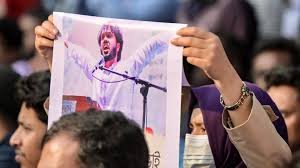
Sharif Osman Hadi was a politician, activist, and youth political figure from Bangladesh, becoming a leading figure in political turmoil in 2024 and 2025 for that country. Born in 1993, he hailed from Jhalakathi District and got involved with youth political groups during a time when there was an escalation of dissatisfaction with existing political leaders and governance issues in Bangladesh. Hadi eventually became a head of a political section called Inqilab Moncho, which pushed for a political transformation and challenged existing political domination from Awami League, among others.
Hadi rose to fame during major movements that rocked the country:
a.) Freedom Movement
Hadi became an
The July Revolution (2024): A series of protests that took place throughout 2024, involving students and society at large, that brought about significant political change. Hadi was one of the voices behind this protest movement, recognized for exhorting youth to call for accountability, justice, and a halt to the trend of authoritarianism.
Assassination attempt and death: Hadi was gunned down in his head by masked gunmen on December 12, 2025, while campaigning for a seat in parliament in Dhaka to participate in the general election scheduled to take place in February 2026. He was rushed to Singapore for medical attention and eventually died on December 18, 2025.
His death is viewed as though it is not only a tragedy for his fans, but a sort of attack on a political movement – particularly because of the political tension that existed between political factions in Bangladesh.
- “Immediate Outbreak of Protests and Violence”
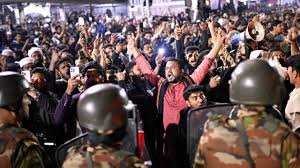
When the news of Hadi’s death reached Bangladesh, especially on the night of December 18–19, 2025, violent protests broke out in Dhaka and other cities:
Massive Demonstrations and Aggression
protected
Thousands of people, including students and young protesting activists, poured out into the streets, especially around the central parts of Dhaka, like Shahbagh, a long-standing rallying point for students, shouting their anti-government protests cries against the killing of Hadi.
The Federal
Protesters were quick to capitalize on the widespread discontent in the political elite and the absence of accountability for the use of violence against political activists.
Attacks on the Media and Institutions
Some of the most appalling that have occurred during the unrest include:
Storming and burning the offices of leading newspapers such as “Prothom Alo” and “The Daily Star” in Dhaka. The journalists were said to have been trapped inside and had to be rescued by the fire services and security personnel.
Vandalism of political offices, residences, as well as properties associated with Awami League (the political party of former prime minister Sheikh Hasina) in Dhaka, Chittagong (also known as Chattogram), and Rajshahi, with reports of road blockades and arson attacks.
There were demonstrations and attacks on the residence of the Assistant High Commissioner for India in the city of Chittagong, amid growing anti-Indian feelings among certain sectors of the protesters.
- Political Context: Why the Tensions Are So High
In order to grasp the magnitude of Hadi’s killing, it is necessary to consider the past political history of Bangladesh.
a. The 2024–25 Political Up
Bangladesh politics in the past few years has been remarkably volatile:
The July Revolution of 2024 represented one of the large-scale protests and occurred mainly due to the involvement of students and organizations from civil society against the political corruption and authoritarianism. This culminated in the resignation of long-serving Prime Minister Sheikh Hasina. Hadi is one of the most vocal leaders in this struggle.
Following this revolution, a new interim government under Nobel winner Muhammad Yunus has been formed in Bangladesh to stabilize this nation and hold elections for early 2026.
This has been a time of sharp polarization between those who seek structural political change and the vestiges of the old party establishments.
b. Anti-India Sentiment and Diplomatic Strain
During the recent unrest:
The pro-Hadi protesters were full of anti-Indian sentiments since India was perceived to have excessive control over the internal politics of Bangladesh, especially when Sheikh Hasina sought refuge in India after she left the government.
Indian diplomatic missions have been targeted by some protesters, and the Indian embassy demonstrations have increased diplomatic tensions between Bangladesh and India.
- Who Are the Protesters and What Are Their Demands?
These protests have not been monolithic. There have been a few key groups and reasons that have defined these events:
a. Student and Youth Activists
Many among the protesters may be either students or youth, especially if one considers that they feel politically marginalized. They see in Hadi a symbol of resistance and justice.
“Their slogans included references to Hadi’s name and calls for accountability for his death,”
b. Political Groups and Civil Society Organizations
A wide array of political and civil society actors, ranging from moderate reform-oriented bodies to radical sectors, engaged in protesting.
“Some groups have capitalized on existing anti-establishment feelings, demanding systemic changes, transparency, and freedom of political dissent,” one commentator notes.
c. Wider Public Frustration
Economic immobility, unemployment of the youth, and the related views on corruption and a lack of promises being kept also played a part.
- Role of Media, Communications, and Public Opinion
a. Attacks on Media Outlets
In relation to the mentioned aspects, there were disturbing cases of violence against news media institutions in these protests, such as:
Offices belonging to pro-government and independent newspapers were vandalized and burnt, including major Bangladeshi news organizations.
Journalists were also trapped, requiring a rescue operation, which highlights the challenges associated with freedom of the press and the role of the press during periods of political turmoil.
b. Story Battles
Some media organizations were accused by the protesters of having ties with foreign countries or opposition groups.
Social media was also crucial to the organization of the protests, in addition to the amplification and escalation of stories that tended to heighten tension.
- Response of the Government and Law Enforcement Agencies
In reaction to the unrest:
a. State of Mourning and Political Statements
The interim leader, Muhammad Yunus, announced the national day of mourning for Hadi.
The authorities appealed to citizens to remain calm and get behind an investigation into the assassination.
b. Deployment of Security Forces
The government also employed other police and para-military forces to maintain order and control the sit-ins.
However, the strength of clashes in cities such as Dhaka established a serious problem regarding preserving public order without increasing the level of violence.
- Historical Parallels and Long-Term Causes
Bangladesh has a history of political involvement by student movements and street politics going back to the struggle for independence in the 1970s:
Student activism was very instrumental in the gaining of independence for Bangladesh and other political transitions.
In more recent decades, student movements tended to coincide and conflict with political crises, such as police conflicts and political groups.
These kinds of historical patterns help to explain not only how student leaders such as Hadi might become powerful symbols but also how violence might break out so suddenly when such leaders are attacked.
- Wider Regional & Global Ramifications
To
a. Effects on BD-India Relations
Attacks on Indian diplomatic missions and increased aggressive rhetoric against India might make bilateral relationsiteture.
Both nations have strong economic, cultural, and security ties; any resurgence of tensions may result in complicated cooperation with regard to trade, terrorism, and regional security.
b. Implications for South Asian Politics
Considering the implications
Bangladesh can have implications for the geopolitical affairs of South Asia, particularly in terms of global realignments. This can be linked to its political instabilities.
It could also impact migration patterns, regional economies, and international politics.
- The Upcoming Elections and What This Means for Bangladesh’s Future
With elections taking place in the nation in February 2026, there is growing concern that the current unrest could:
- Influence voting behavior – molding platforms and reputation of contenders, Effects election credibility if violence deters people from joining or results in security crackdowns, Fuel polarization between political groups, particularly with banned or discredited political parties during the recent outbreaks of upheavals. The passing of Hadi complicates an election that must take place in a very short period. 10. What Happens Next? Key Scenarios a. De-escalation and Dialogue If dialogue between political leaders and civil society is undertaken, there may be a chance that the tension can be eased and a platform for peaceful political participation may be established before the elections. b. Continued Violence and Crackdowns Further protests could trigger tougher measures of security, possibly creating further resentment and concerns about human rights. C. Effect on Political Reform The government’s actions with respect to investigation into the assassination and freedom of the media will be closely monitored domestically as well as internationally. Conclusion Essentially, the current incidents of violence and protests in Bangladesh have been instigated by: 1. The death of Shariff Osman Hadi, one of the main youth leaders whose killing Triggered renewed political resentments. 2. Political polarization that has existed for a long time, a lack of confidence in the traditional parties, and unresolved grievances from the previous upris 3. Sudden escalation into violent protests, as well as attacks on news organizations and embassies. 4. The broader questions relating to the matter are: “4. The broader questions relating to the matter are:
- The broader questions relating to