SpiceJet aircraft clips tail of another plane in minor ground collision
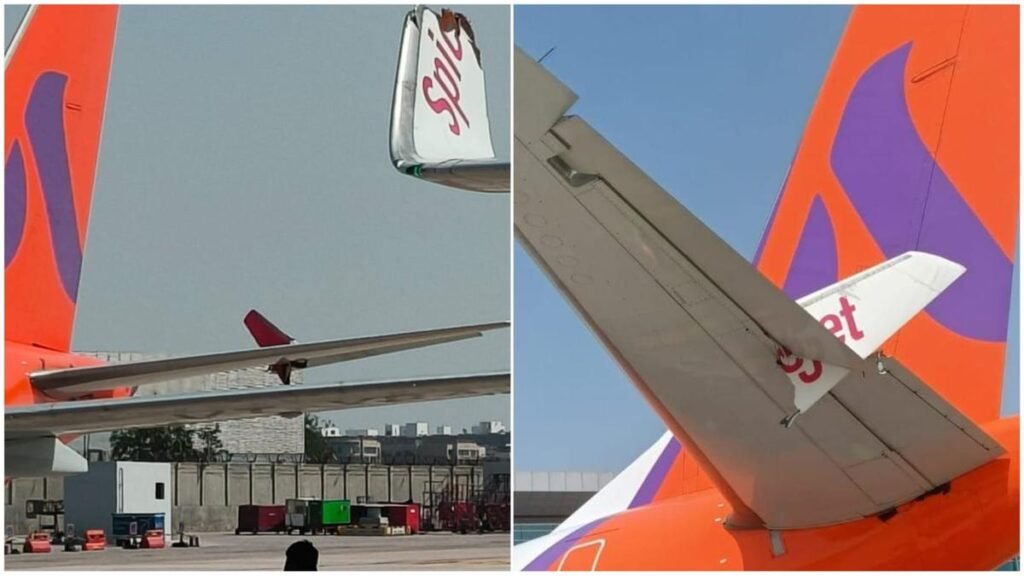
The incident involving a SpiceJet aircraft clipping the tail of another plane is a recent aviation ground accident that occurred at Indira Gandhi International Airport (IGI), Delhi, on April 16, 2026. While it has been described as a minor ground collision, it raises important questions about airport safety, aircraft movement procedures, and aviation regulations.
1. What Exactly Happened?
On April 16, 2026, a SpiceJet Boeing 737-700 aircraft was taxiing (moving on the ground) after landing when it collided with another aircraft belonging to Akasa Air.
- The SpiceJet plane had just arrived from Leh (flight SG-124)
- The Akasa Air aircraft was preparing for departure to Hyderabad (flight QP-1406)
- The collision occurred at Terminal 1 apron/taxiway area
Key physical impact:
- The right winglet (tip of the wing) of the SpiceJet aircraft
- Hit the horizontal tail (rear stabilizer) of the Akasa aircraft
As a result, both planes were damaged
2. Nature of the Collision: Why It Is Called “Minor”
This incident is categorized as a ground collision, not a crash.
Why “minor”?
- It happened on the ground, not in the air
- There was no fire or explosion
- No injuries or fatalities were reported
- Damage was limited to external aircraft parts
Passengers on the Akasa Air flight were safely deboarded and given alternate arrangements
3. Understanding “Taxiing” in Aviation
To understand the incident, you must know what taxiing means.
Taxiing refers to:
- Aircraft movement on the runway or taxiways
- Occurs before takeoff or after landing
Risks during taxiing:
- Limited visibility from cockpit
- Congested airport ground traffic
- Dependence on Air Traffic Control (ATC) instructions
Even though aircraft move slowly, precision is critical because wingspans are very large.
4. How Did the Collision Likely Occur?
Based on initial reports:
- The Akasa aircraft was stationary or preparing for takeoff
- The SpiceJet aircraft was taxiing toward its parking bay
- During this movement, wing clearance was misjudged
Possible causes:
- Pilot misjudgment of distance
- Improper ground guidance
- ATC communication issues
- Congestion at airport apron
- Limited visibility or blind spots
The exact cause is under investigation by aviation authorities.
5. Immediate Aftermath
Damage:
- SpiceJet: Right winglet damaged
- Akasa Air: Horizontal tail surface damaged
Operational impact:
- Both aircraft were grounded
- Akasa flight was delayed/cancelled
- Passengers were shifted to alternative flights
Regulatory action:
- DGCA (Directorate General of Civil Aviation) launched an investigation
- Pilots and ATC personnel were taken off duty (de-rostered)
6. Role of DGCA in the Investigation
Directorate General of Civil Aviation
DGCA is India’s aviation safety regulator.
Its responsibilities include:
- Investigating aviation incidents
- Ensuring compliance with safety rules
- Taking disciplinary action if needed
In this case, DGCA is examining:
- Pilot actions
- ATC instructions
- Ground movement procedures
- Airport infrastructure
7. Technical Explanation of the Damage
(a) Winglet
- Located at the tip of aircraft wings
- Improves fuel efficiency and aerodynamics
- Easily damaged in close-contact incidents
(b) Horizontal Stabilizer
- Located at the tail of aircraft
- Controls pitch (up/down movement)
Damage to these parts:
- Does not immediately endanger passengers on ground
- But makes aircraft unfit to fly until repaired
8. Airport Ground Safety: Why Incidents Happen
Even at major airports like IGI, such incidents occur due to:
1. High traffic density
Delhi airport is one of India’s busiest airports.
2. Tight parking spaces
Aircraft are parked close together.
3. Human factors
- Pilot fatigue
- Miscommunication
4. Complexity of operations
- Multiple aircraft moving simultaneously
- Coordination between pilots, ATC, and ground crew
9. What Is a Ground Collision?
A ground collision occurs when:
- Aircraft collide with other aircraft, vehicles, or objects on ground
According to aviation safety studies:
- These incidents are rare but not uncommon
- Usually happen during:
- Taxiing
- Parking
- Pushback operations
10. Comparison with Major Aviation Accidents
This incident is not comparable to major crashes.
| Feature | Ground Collision | Air Crash |
|---|---|---|
| Location | On ground | In air |
| Speed | Low | High |
| Damage | Limited | Severe |
| Casualties | Rare | Often high |
This was a low-risk event but still taken seriously.
11. Impact on Airlines
For SpiceJet:
- Aircraft grounded
- Operational disruption
- Possible financial cost
For Akasa Air:
- Flight delays
- Passenger inconvenience
Such incidents can also:
- Affect airline reputation
- Increase insurance and maintenance costs
12. Safety Protocols That Failed
Aviation has strict rules like:
- Minimum wing clearance distance
- ATC-controlled taxi routes
- Ground radar monitoring
Failure likely occurred in:
- Maintaining safe distance
- Coordination between aircraft and ATC
13. Lessons from the Incident
Key takeaways:
- Importance of precise ground navigation
- Need for better coordination
- Role of technology (ground radar, AI systems)
- Continuous pilot training
14. Broader Aviation Safety Context in India
India’s aviation sector is:
- Rapidly growing
- Handling increasing passenger traffic
This leads to:
- More congestion
- Greater pressure on infrastructure
However:
- Safety standards remain strict
- Most incidents are handled without casualties
The SpiceJet–Akasa Air ground collision at Delhi airport was a minor but significant aviation incident.
- It involved two Boeing 737 aircraft
- Occurred during taxiing operations
- Caused structural damage but no injuries
- Triggered a DGCA investigation
While not dangerous in terms of passenger safety, such incidents highlight:
- The complexity of airport operations
- The importance of strict safety compliance
- The need for continuous improvement in aviation systems