Delhi Police detain two BJP MPs during protest march to Rahul Gandhi’s residence over Constitution Amendment Bill
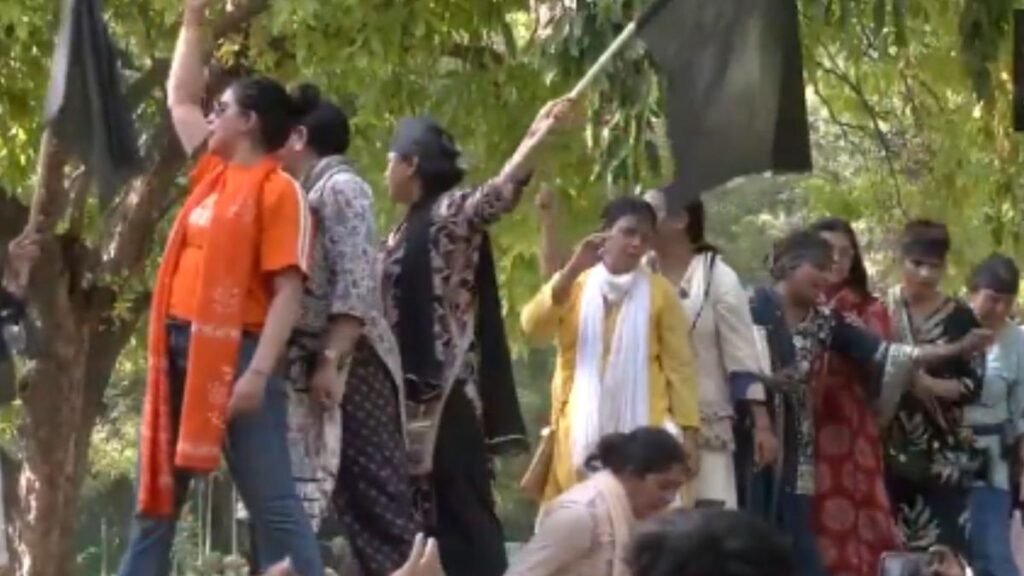
The whole thing started when the Delhi Police took two BJP MPs into custody during a protest march towards Rahul Gandhis house. This is all part of a fight in India about the Constitution Bill, which is about women having a bigger say in politics and changing the way areas are divided for elections.
1. What is the Constitution Amendment Bill about?
The reason for the protest is that the Constitution Bill did not get passed in the Lok Sabha. The BJP government had introduced this bill with two goals:
(a) Women should have more representation in Parliament and state governments.
This is something people have been talking about in India for a time to get more women into politics.
(b) The bill also wanted to change the way areas are divided for elections, based on the population.
It even suggested increasing the number of seats in the Lok Sabha.
👉 This part about changing the areas for elections became a point of contention.
2. Why did the bill not get passed?
Even though the bill was supposed to be a change it did not get passed because it needed a lot of votes in favor.
Votes for the bill: 298
Votes against the bill: around 230
The Congress party and its friends did not agree with the bill but not because they are against women having more representation.
They were against it because:
– Some states were worried they would lose representation if areas were divided based on population.
– Rahul Gandhi said the government was trying to change the election map for its benefit.
– Some people thought the government was using womens representation as an excuse to change the election rules.
3. How did the BJP react?
After the bill did not get passed the BJP started protesting over the country against the opposition parties.
The BJP said the opposition parties had let women down and were against them.
They framed the protest as a fight for women to have power in politics.
This led to a lot of demonstrations across India, including an one in Delhi.
4. The protest march to Rahul Gandhis house
(a) What happened on that day?
On April 18 2026:
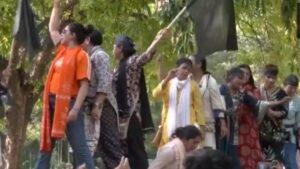
– BJP leaders, including women organized a march towards Rahul Gandhis house in Delhi.
– The protesters shouted slogans burned effigies and carried signs against the Congress party.
– Some known leaders were part of the protest like Bansuri Swaraj, Raksha Khadse, Kamaljeet Sehrawat and Hema Malini.
(b) What did the police do?
When the protesters tried to reach Rahul Gandhis house the Delhi Police stopped them.
They used water cannons. Took some MPs and leaders into custody.
👉 The police did this to maintain law and order.
5. Why were the BJP MPs taken into custody?
The police did not take the MPs into custody randomly; they had reasons for it:
(1) They wanted to protect Rahul Gandhis house, which’s a high-security area.
(2) The protesters did not have permission to march towards the house.
(3) The police were worried the situation might get out of hand with the protesters burning effigies and shouting slogans.
(4) The police often take people into custody to prevent violence not as a punishment.
6. What does the BJP think about all this?
The BJP is criticizing both the opposition parties and the police:
(a) They think the opposition parties are against women and blocked a change.
(b) They think the police were too harsh on the protesters using water cannons and taking people into custody.
7. What does the Congress party think?
The Congress party says it supports womens representation. It was against the bill because it linked womens representation to changing the election areas.
They think the BJP used this issue to get an advantage in politics.
Rahul Gandhi thinks the bill was a move to change the way elections are held.
8. What are the bigger issues here?
This incident is not about a protest; it is about deeper debates in India:
(a) Womens representation in politics is still low in India and the bill was trying to address this.
(b) Changing the election areas based on population creates tension between states with low populations.
(c) Some states are worried they will lose their voice in politics if the election areas are changed.
9. What does this incident mean for politics?
The detention of the MPs is important because it shows how divided politics in India has become.
It also shows that when there is no agreement in Parliament the fight moves to the streets.
10. What is the role of the Delhi Police?
The Delhi Police is responsible for maintaining law and order in Delhi around important areas like Rahul Gandhis house.
They have to balance allowing protests with maintaining security.
11. Has something like this happened before?
Yes MPs have been detained during protests before like during the CAA protests in 2019. The TMC protests in Delhi in 2026.
This shows a pattern where protests and police control become a battle for narrative.
12. What are the bigger questions here?
This incident raises questions about:
(a) How should protests be allowed near sensitive areas?
(b) Is it necessary to take people into custody to prevent violence?
(c) Should big changes in politics be decided in Parliament or can they be decided on the streets?
13. How will this affect politics in the future?
In the term this will likely increase the divide between parties and lead to more protests.
In the term the issue of womens representation and changing election areas will remain unresolved and might get more intense before the next elections.
14.
The detention of the BJP MPs during the protest march to Rahul Gandhis house is not a law-and-order issue; it is a part of a bigger fight in Indian politics.
At its core this is about womens empowerment, changing election areas and the struggle for power between parties.
The BJP thinks the opposition parties let women down while the opposition parties think the BJP is trying to change the election rules, for its benefit.
This protest and the police action show how divided Indian politics has become over changes. It also shows that when parties do not agree in Parliament they take the fight to the streets.